For orthopedic physical therapists

You were told clarity takes three to five years.

That the guessing is normal. That one day it clicks. That what you're feeling is imposter syndrome. It isn't. And it doesn't click on its own.

Every clinician whose patients plateau at 80% was taught the same way you were. Subjective. Range of motion. Special tests. Strength. A checklist that tells you what to do next but never what to do with what you find.

Stop Guessing is the framework that turns those findings into a decision you can defend.

Step 1 of 2

Where should we send your copy?

Enter your details and you'll get instant access on the next page.

All fields required

$9.99 · instant download · no subscription

We'll email your copy and occasional clinical breakdowns. Unsubscribe any time. See our privacy policy.

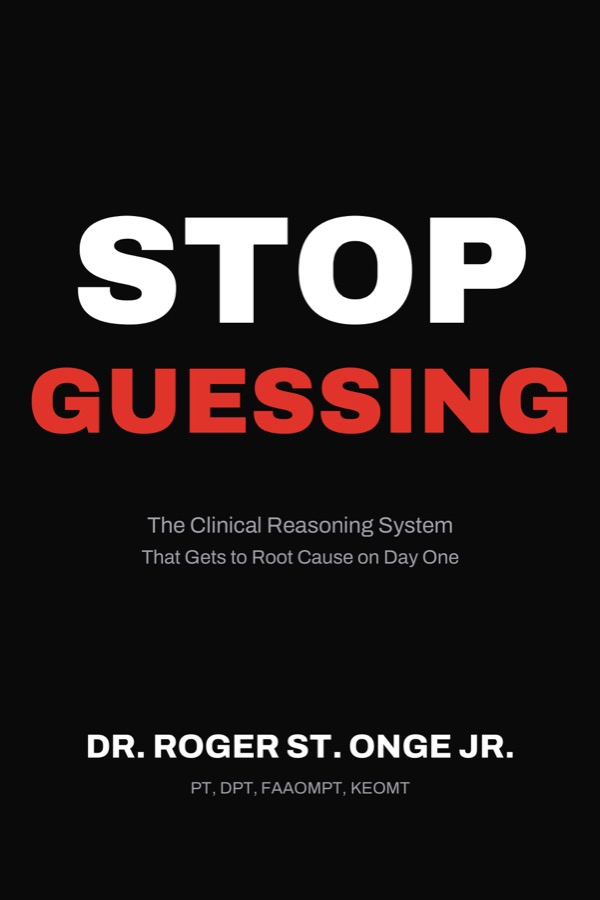
Stop Guessing book cover
267 pages · PDF e-book · by Dr. Roger St. Onge Jr., PT, DPT, FAAOMPT, KEOMT

It was never a knowledge problem.

You already have the anatomy, the biomechanics, the tests. What you don't have is the framework that organizes them into a decision.

So you collect positive findings, pick the one that looks most likely, and treat it. When the patient stalls, you swap the exercises and hope. It works often enough that you never name the problem, and fails on exactly the patients who needed you to get it right.

That gap is not a gap in what you were taught. It's a gap in what nobody teaches: the layer between gathering findings and deciding what they mean.

You'll recognize this if…

★★★★★
Wish I learned to evaluate pts this way when I was in school.
KCooley58, Amazon review

What's inside

Four things you'll be able to do differently.

  1. Get to root cause on day one

    Not after four visits of ruling things out. A first session that ends with a plan you can defend, because you know what is actually driving the presentation.

  2. Identify the mechanical stressor before you touch the patient

    The subjective is not a formality you get through before the real exam. Done properly it tells you what the hands-on findings are going to mean before you gather them.

  3. Separate a spine-driven problem from local tissue

    Even when every finding points local on the surface. This is the differentiation that decides whether the shoulder you are treating is actually a shoulder.

  4. Know when a patient is recovered, not just asymptomatic

    A discharge criterion that holds up. The difference between the patient who stays better and the one who is back on your schedule in three months for the same thing.

GET THE BOOK FOR $9.99 →


Why the other stuff hasn't fixed it

You can take every course there is and still be guessing.

Not because the courses are bad. Because they all add to what you know, and the bottleneck was never that you are missing knowledge.

ApproachHow it worksWhy it fails
Weekend CEU coursesTwo days learning a technique or a test clusterIt makes sense in the room. Then Monday comes and the patient in front of you is not the one from the demo. You keep a tool or two. Nothing about how you reason changed.
ResidencyA year of structured training under a program curriculumIt is built around the standards of academia. You have had plenty of academia. What is missing is how to apply all of it to the patient who is in front of you right now. I went the whole route, residency and two fellowships, and still had to build that part myself.
Asking a senior clinicianTake the hard case to someone with more yearsMost of them are running on their own trial and error, doing things that have worked often enough. That is a habit, not a system, so there is nothing to hand over. You get their answer for that patient and no way to reach it yourself next time.
Giving it more timeKeep practicing and wait for it to clickThis is the one almost everyone picks, because it is what you were promised. Ask a clinician twenty-six years in whether it arrived.
Stop GuessingA systematic, algorithmic way of thinking that you run on the patient in front of youIt does not fail you on the hard ones. It gets you to root cause on day one, tells you exactly what to do for that patient, and tells you when they are actually recovered instead of just asymptomatic.

Dr. Roger St. Onge Jr.
The author

Dr. Roger St. Onge Jr.

PT, DPT, FAAOMPT, KEOMT

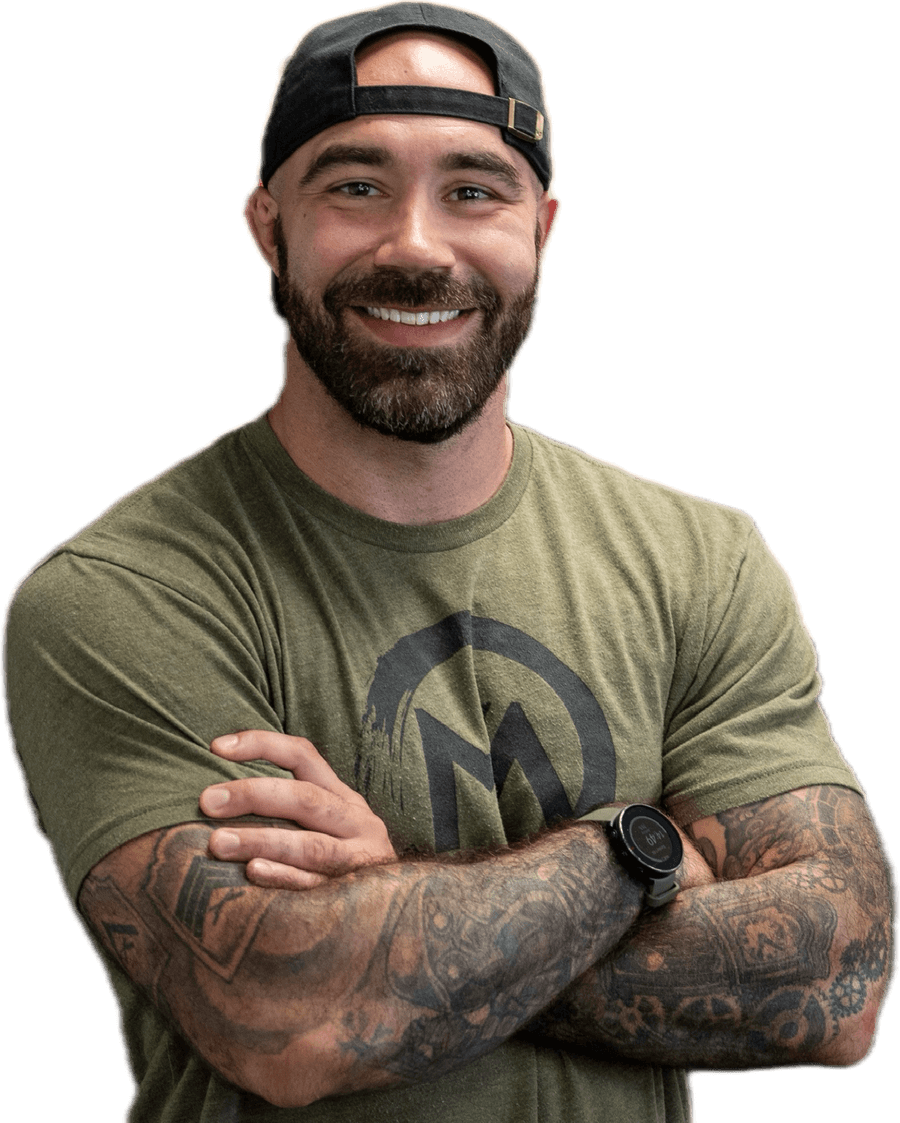
Dr. Roger St. Onge Jr. is a residency and dual fellowship-trained orthopedic physical therapist and the founder of Performance Rehab Authority. He spent a decade building the system he wishes he had, and has now taught it to hundreds of clinicians, from new grads to fellows to 40-year veterans.

Stop Guessing is that system, written down.


What clinicians say

The same system, from the people running it.

These clinicians learned this reasoning through the Performance Rehab Authority coaching program. Stop Guessing is that system written down: the same framework, in book form.

Tried one more time instead of leaving

Before PRA I struggled with significant burnout as a new grad. I didn't really know where to start an eval. It got to the point of wanting to leave the profession. I'd basically cry every morning on the way to work, because I didn't feel like I could do it. I wanted to put forth the effort one more time before I decided to quit. It's given me better clinical thinking than any other continuing education class I've taken, and it gives results fast when you use the material.

Hanna Johnson, PT
Telehealth PT, 2 years · Utah · PRA Clinical Coaching Program member
Eased a surgical candidate in one session

Before PRA, my biggest struggle was the evals that weren't straightforward. Finding the right tests, then choosing what to do from there. I felt like I was faking it. It would help for a little bit, then my patients would get stuck and I couldn't figure out where to go. I had patients coming in for shoulder pain who were about to have a total shoulder replacement and thought they were never going to get helped. I was able to ease their pain within the first session. I leave work at work now. I can come home and enjoy my family.

Nicole Kajut, DPT
Outpatient PT, 5 years · Austin, TX · PRA Clinical Coaching Program member
30 years of courses. Still no road map.

I've been in the orthopedic setting almost my whole career. I started in 1997, so getting close to 30 years. I've been a solo practitioner most of it, so I missed out on working alongside other physical therapists to throw ideas off. Thirty years of required continuing ed means a ton of courses, and most of them were just a rendition of PT school. Anatomy again, when what we needed was how to actually treat these patients. It's always "I'm a shoulder specialist, this is what I do for the shoulder." And I'm thinking, something's missing, because my patient can't even lift his arm into that position. This gives you the reason why, and what path to take.


What readers say

Reviews from people who bought the book.

Left on Amazon, where the reviewer had nothing to gain by writing one.

★★★★★

A Treasure Chest of Orthopedic Evaluation

An absolute goldmine of orthopedic evaluation and clinical treatment reasoning. Every day in this country tens of thousands of patients are getting cookie cutter approaches in physical therapy clinics with subpar outcomes. The tax for isn’t only the dollars being poorly spent by individuals and the system at large, but the even bigger price is the loss of hope patients experience when they don’t get better and progress as they should because providers missed something(s) in their evals and treatment plans. This book should be on the shelves of every physical therapist, chiropractor, manual and movement therapists.

Zachary Comer·September 25, 2026·Verified Purchase
★★★★★

Wish I learned this in school!!

Should have the hard copy today but already went through the audiobook. Wish I learned to evaluate pts this way when I was in school. This book helps to organize your testing and thoughts to be able to make confident judgements on what is really going on with a patient and to be able to help them where other therapists couldn’t. This method should be taught in every PT school.

KCooley58·September 20, 2026·Verified Purchase
★★★★★

Great read with knowledge you can apply immediately to your caseload!

Great book! I really enjoyed the thought process behind how to systematically break down your evaluations and truly diagnose patients beyond just “shoulder impingement”. The information here is valuable to outpatient PTs of all levels and I think the feelings about coming out of PT school but still not having a true system will resonate with a lot of clinicians. Highly recommend this book and already excited to take these concepts and implement them to my caseload this week! It’s cool to see another strong advocate for our profession giving useful knowledge so we can all grow and provide the quality of care our patients deserve and the type of care we all got into this profession to provide!

Steve·September 20, 2026
★★★★★

Foundational Treatment that gets Results!

Rodger is a master of diagnostic screening tools for finding and treating the root cause of patients issues, resulting in better patient care and outcomes. I would recommend his classes, book and training for any practicing rehabilitation therapist to learn more effective ways of treatment, or different approaches to broaden your understanding and practice.

Amazon Customer·September 20, 2026·Verified Purchase

Read every review on Amazon →


What you get

Everything, for the price of a coffee.

Stop Guessing (PDF e-book, 267 pages)$29
24-Hour Clock Patient Interview Guide$47
Squat Assessment Algorithm$47
The complete audiobook, read by me$19.95
Total value$142.95
Your price today$9.99

24-Hour Clock Patient Interview Guide: The interview structure that surfaces the mechanical stressor before you lay a hand on the patient.

Squat Assessment Algorithm: A one-page decision tree for turning a squat screen into a defensible plan.

The complete audiobook, read by me: Eight hours and nineteen minutes, read by me, including forty-four minutes of commentary between chapters that is not in the print edition. Unlocks in the community: Skool emails you an invite, and clicking it is what grants access, even if you are already a member.

GET INSTANT ACCESS FOR $9.99 →

Prefer print?

Paperback and hardcover on Amazon

Same book, same bonus guides. Every edition points you to them. Pick your format on Amazon. The PDF e-book here arrives in your inbox the moment you buy it, instead of on your doorstep in a few days.


Questions

Straight answers.

Is this just another technique course in book form?

No. There is not a new technique in it. Stop Guessing is about what you do with findings you already know how to collect. It is the layer between the exam and the plan that nobody teaches directly. The techniques you already have work fine once they are pointed at the right thing.

I am a new grad. Is this too advanced?

It is the opposite problem. New grads benefit most, because you have not yet spent five years building habits around guessing. You need the anatomy, biomechanics, and standard special tests from your program. After that, this gives you the structure those courses assumed you would pick up on your own.

I have been practicing fifteen years. Is there anything here for me?

Yes, and the fact that you are still asking is the answer. If fifteen years has not closed the gap, another five will not either. That is the argument the book opens with. Nicole came to this at 26 years and said she was still putting a band-aid on low back pain and never moving forward. Bradley came at 30 years and a career of mandatory continuing ed and said none of it gave him a road map. Experience hands you more tools and better instincts. It does not hand you a rule for which one to reach for, and that does not arrive on its own.

What exactly do I get, and when?

The complete 267-page PDF e-book, downloadable the moment you pay, with no waiting on shipping, no waiting on an email. The two bonus guides come with it. So does the complete audiobook, read by me, which unlocks inside the free Performance Rehab Authority community on Skool, where the free shoulder course and Clinical Essentials also live.

Do I have to join the community?

No. The download is yours immediately and independently. The community is included because the reasoning gets sharper when you watch it applied to cases that are not yours, but the book stands entirely on its own.

Why is it only $9.99?

Because the constraint on this material has never been demand, it has been getting clinicians to try it. The book took a decade to build and prices like a coffee, and that is deliberate: read it, use it on Monday, and decide for yourself whether the deeper training is worth your time. There is no subscription, no trial, and no recurring charge.

Is there a refund policy?

Yes. If it does not change how you evaluate your next patient, email support@performancerehab.co within 30 days and you get your money back. You keep the file. There is no way to take a PDF back and no reason to pretend otherwise.

Can I claim CEUs for this?

Not for the book itself. It is professional education, not an accredited course. Performance Rehab Authority Clinical Coaching Program is where the accredited CEU training lives.

The patients are already on your schedule.

You can spend another three to five years hoping it suddenly clicks, or you can read the 267 pages that explain what you were never taught.

STOP GUESSING FOR $9.99 →

Instant download · 30-day refund · No subscription